
Sympla.
Design leadership for one of Brazil's largest ticketing platforms, measured by customer pain and not by output.
- Head of Product Design, then also Group Product Manager, Mobile
- 2022 to 2024
4 designers. Six months in, also Group Product Manager for mobile, with 4 engineers. In 2023, product satisfaction reached 85% (up 5 points) and brand promotion 79% (up 13 points). The design team moved up a full level on the NN/g UX maturity model.
The team
I promoted three of the four designers. One-to-ones every two weeks as the base, and the cadence adjusted to each person: weekly when someone needed it, further apart when not.
How the team moved up a level
The baseline
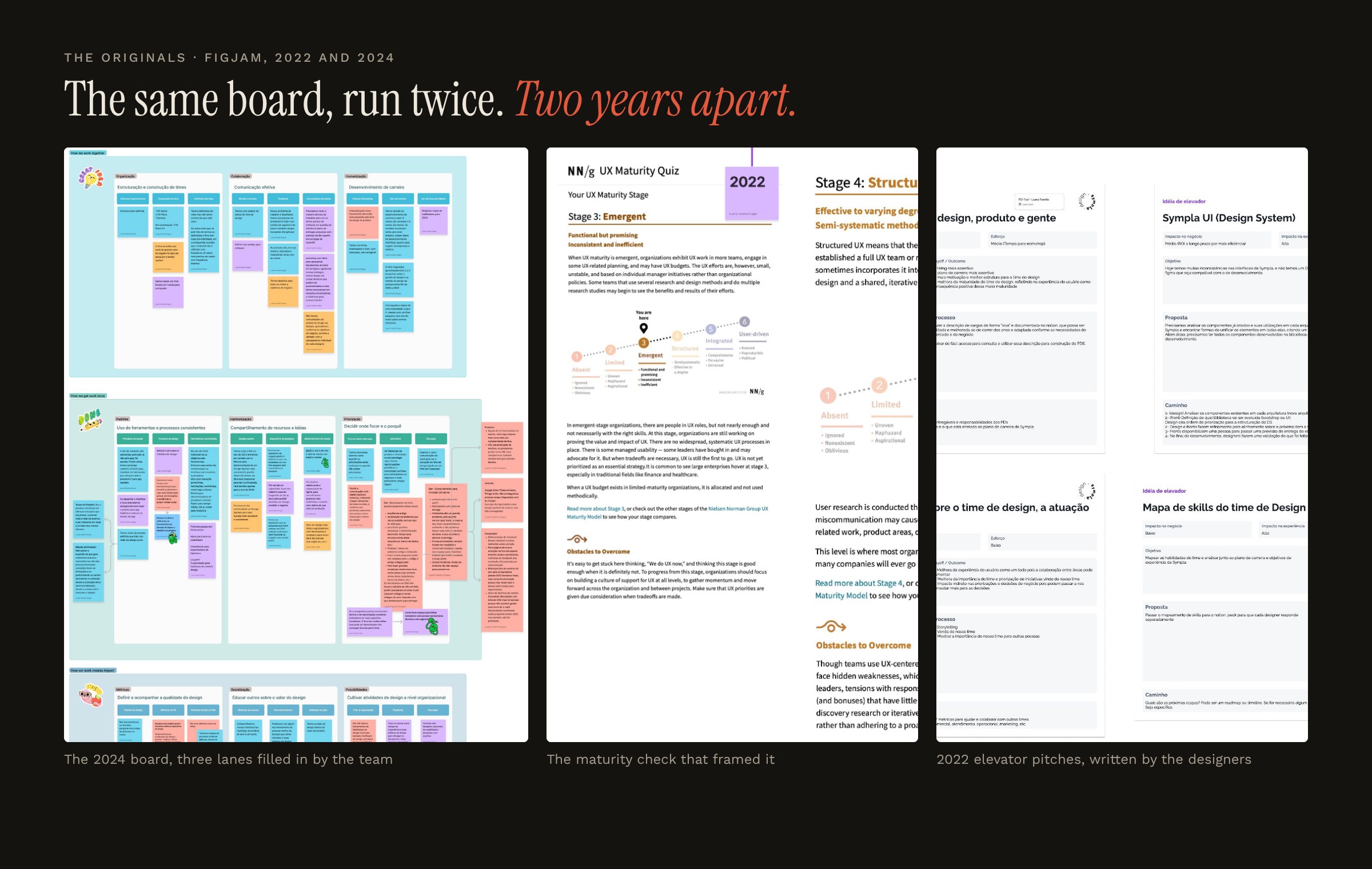
In 2022 the team took the Nielsen Norman Group UX maturity quiz and landed at Stage 3, Emergent: functional but promising, inconsistent and inefficient. Design work existed, but it ran on individual initiative.
Absent
Limited
Emergent
Structured
Integrated
User-driven
Stage names from the Nielsen Norman Group UX maturity model.
The board
Instead of writing a plan alone, I ran a Design Ops analysis with the team on one board: nine questions in three lanes (how we work together, how we get work done, how our work creates impact). Every designer added notes in four colors: what we know, assumptions to prove, doubts and pains, and new ideas.
How we work together
Structuring and building teams
Communicating effectively
Career development
How we get work done
Consistent tools and processes
Sharing resources and ideas
Deciding where to focus, and why
How our work creates impact
Defining and tracking design quality
Teaching others the value of design
Growing design across the organization
- What we know
- Assumptions to prove
- Doubts and pains
- New ideas
Ideas as pitches
Any idea had to arrive as an elevator pitch: business impact, UX impact, effort, objective, payoff, proposal, process and path. Fifteen pitches, thirteen written up. They included co-created job descriptions, a "Design Friday" for Design Ops and the design system, one design system across every Sympla architecture, a UX bug repository, a research repository, and a design metrics board.
15
13
- 1 Business impact
- 2 UX impact
- 3 Effort
- 4 Objective
- 5 Payoff
- 6 Proposal
- 7 Process
- 8 Path
- Co-created job descriptions
- Design Friday for Design Ops and the design system
- One design system across every Sympla architecture
- A UX bug repository
- A research repository
- A design metrics board
Two years later
In 2024 the team ran the same board and the same quiz again: Stage 4, Structured. The organization recognized the value of design, and the team shared one definition of design and one process.
The problem, and the constraint
A consumer marketplace at high traffic, where the expensive moments are payment, fraud and the ticket itself. Six months in, I also took product management for mobile, so the decisions about what shipped were mine as well as the design.
The choice, and what I refused
We tied design work to customer pain metrics, monitored continuously, and not to the volume of screens delivered: A/B and A/B/C tests, CSAT, SUS, NPS, analytics, and watching sales happen.
The same rule held for the future bets. We designed a concept for the full event journey, before, during and after, and tested ideas in the street with guerrilla tests. We split the concept into MVPs and shipped only the first, tokenised tickets, behind a feature flag, and not the whole vision at once. Any event could then choose to issue its tickets on blockchain.
I led the tokenised ticket and six new mobile experiences aimed at payment friction and risk.
What stayed after
The metrics. Satisfaction and brand promotion were measured against the pain they were meant to reduce, and the team that measured them had moved up a full maturity level.