
Crypto Exchange Gamification.
Helping people understand crypto investing, one level at a time.
Mercado Bitcoin work is under NDA. Internal user and volume figures, and business targets, are left out of this page.
The problem
The exchange offered cryptocurrencies, digital assets, tokens and NFTs. The challenge: help people understand investing in crypto, and engage them so the product felt less intimidating. Neither the company nor I knew how to apply gamification well at the start, so I studied it from scratch and used Octalysis, Yu-kai Chou's framework of eight core drives, as the lens for every decision. A new squad was created to build it.
The audit
Before adding a single badge, I scored the product as it was against the eight core drives. It already did a lot without knowing it: a sense of mission in the home page, a financial bio the person builds themselves, live trading volume as social proof, fee levels that unlock with use. And it had gaps: a sign-up progress bar with no reward at the end, a 24-hour link with no explained consequence.
Before adding a single badge, I scored what the product already made people feel.
Point at a drive or a piece of the octagon to link them.
CD1 Epic meaning
"Reinvent yourself" in the home, carbon-reducing assets. Present
CD2 Accomplishment
"Step 1 of 6" progress in sign up, but no reward at the end. Gap
CD4 Ownership
Financial bio built by the person, their name at the top. Present
CD6 Scarcity
A link valid for 24 hours after sign up, with no consequence explained. Gap
Current
experience
CD3 Empowerment
Financial bio suggests an investor profile. Fee levels unlock with volume. Present
CD5 Social influence
"260.90 ETH traded in 24 hours", testimonials, token indicators. Present
CD7 Unpredictability
Notifications about news and new coins; a bright deposit button. Present
CD8 Loss and avoidance
Fee level drops if you stop investing. Pre-listing tags, very light.
The call
Four player types, mapped by knowledge and behavior. Merchants were a small share of users and moved most of the volume. Beginners were the large majority of users. We designed the first version for the beginners, and not for the experts.
Most users were beginners. We designed for them first.
Beginners
Explorers who dislike unpredictability, sell too early for fear of loss, and listen to friends and family. Ashamed of losses, quick to withdraw.
Apprentices
Little income, many small orders to learn how the market works. Follow experts.
Farmers
Long-term holders who take risks but do not leave when they lose progress.
Merchants
The experts, who move most of the money and like scarcity and risk. The obvious first audience.
The drives explain why that changes the design. Merchants are moved by loss and avoidance (CD8): scarcity and risk work on them. Beginners are moved by empowerment, social influence and unpredictability (CD3, CD5, CD7), the intrinsic drives on the right of the octagon. They listen to friends and family, they are ashamed of their losses, and they withdraw their money as soon as they feel they are losing. Fear of missing out would push them out, and not in.
Experts are moved by fear of loss. Beginners are moved by creativity, people and curiosity.
Beginners
Apprentices
Farmers
Merchants
From 24 ideas to one MVP
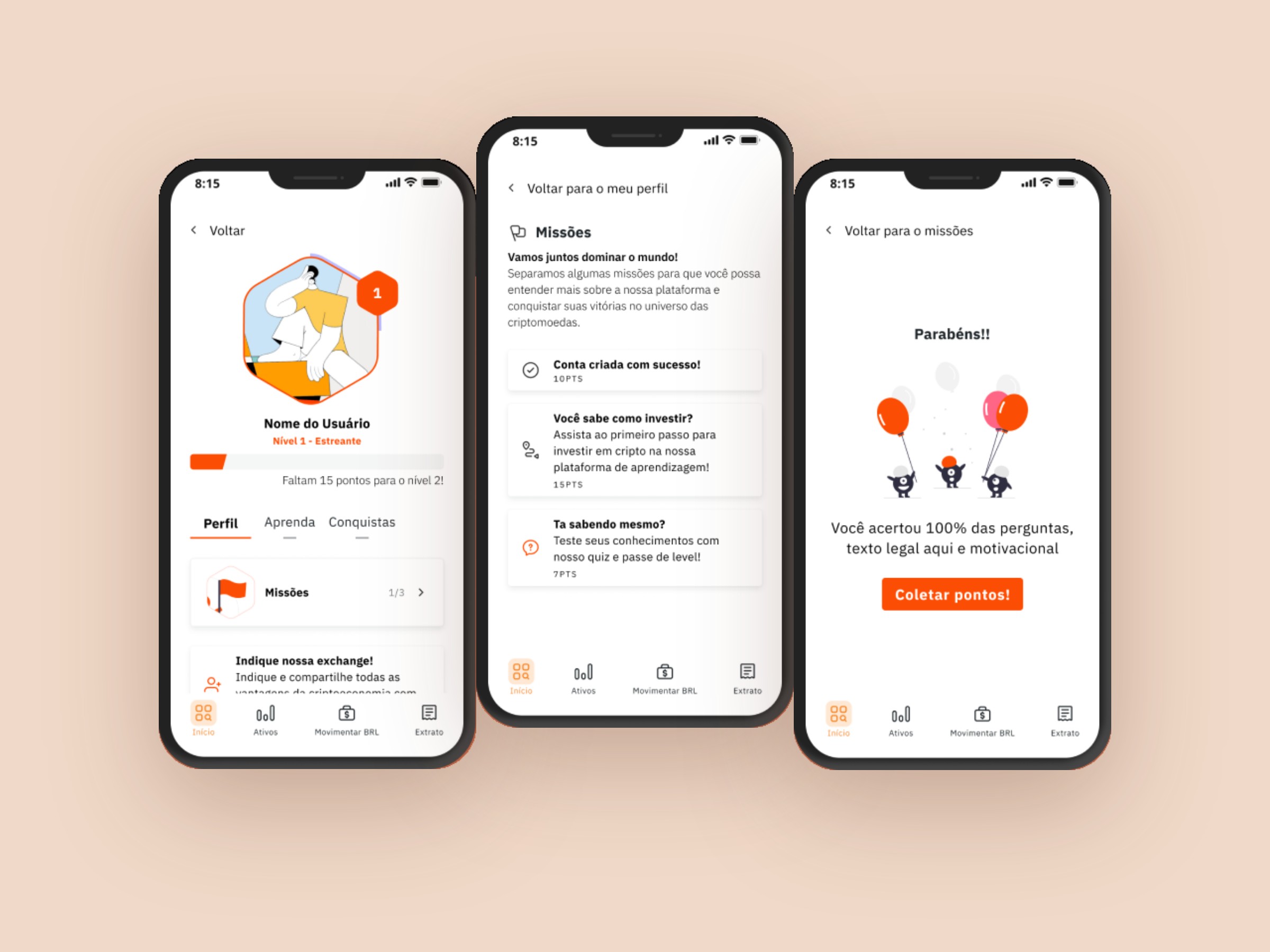
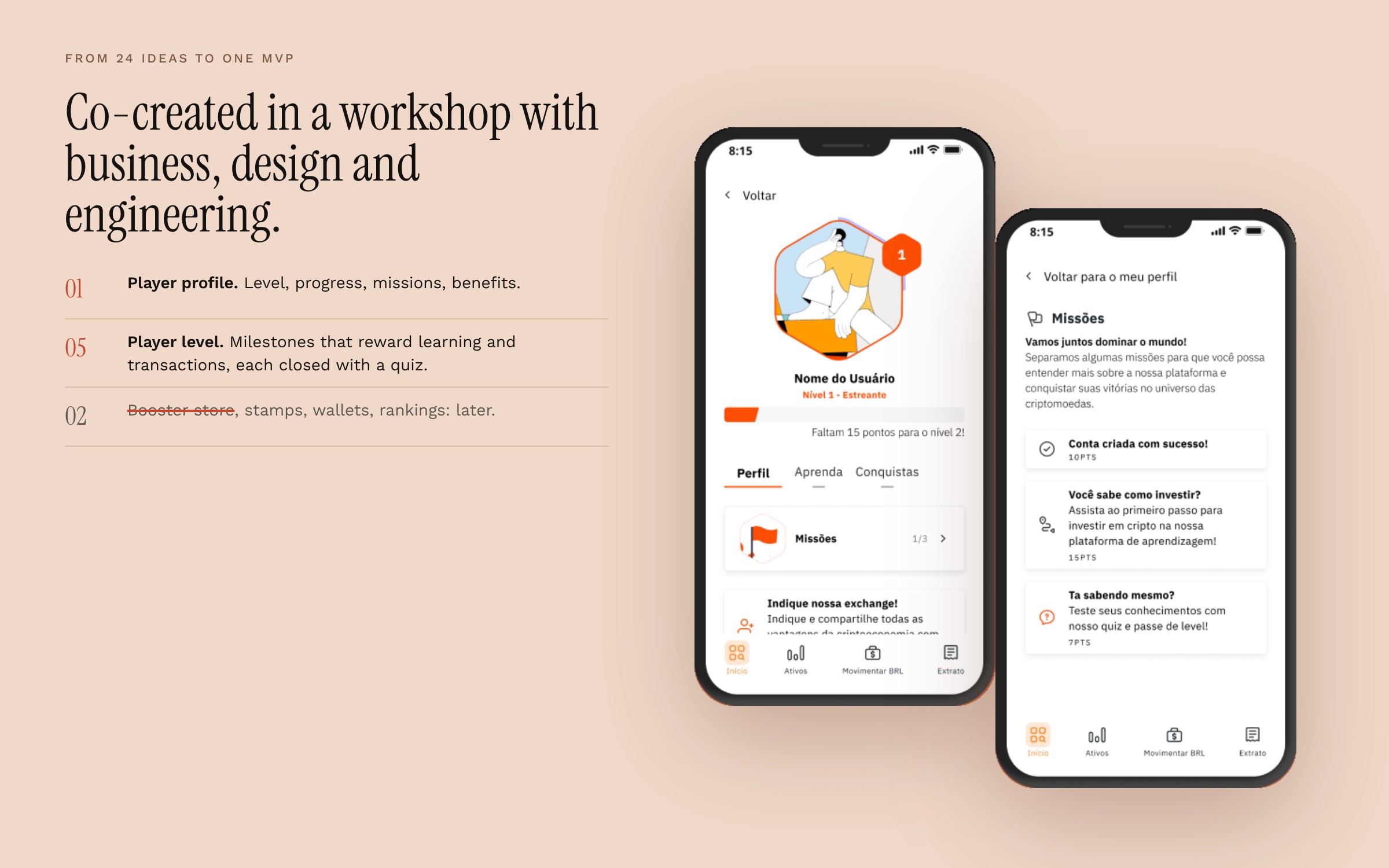
Every idea in the brainstorm was tagged with the drives it activates. The set leaned white hat, fourteen tags to seven, with empowerment and social influence at the top, which is where the beginners lean. In a workshop with business leaders, designers and developers, we chose the first feature together: the player area, with a profile, a level, missions and a quiz at the end of each milestone. It runs on accomplishment, empowerment and ownership.
The ideas leaned where the beginners lean, and the MVP leaned further.
White hat · Feels good
Middle
Black hat · Feels urgent
The strategy board
Every mechanic was traced to a business metric before it was designed: what the player commits to, how they track progress, what triggers the next action, and which number it moves.
No badge without a number behind it. Fun was the means, not the goal.
The business targets set for each metric are internal and left out.
Four phases. We built for the third one.
Discovery
- Reads about crypto
- Compares exchanges
- Registers
Onboarding
- Activates account and 2FA
- Verifies ID
- Fills financial profile
Scaffolding
- Opens the app daily
- Makes the first deposit
- Learns about new products
- Creates alerts, buys, sells
End game
- Joins campaigns
- Shares knowledge
- Brings friends and family
The takeaway
We designed for one player, not four. Beginners were the large majority of users, so the first version was built for them and for the Scaffolding phase, and Merchants were left out.
Every mechanic had to trace back to a business metric on the strategy board. Of the 24 ideas, the MVP kept the player profile and player level, which run on accomplishment, empowerment and ownership, with no black hat drives. The booster store, stamps, wallets and rankings were left for later.