
Mercado Bitcoin, design team.
Building the operating system for a design team of thirteen, and making the hardest call it ever asked for.
All Mercado Bitcoin work is under NDA. Diagrams are redrawn, names and salaries removed.
Listening first
In my first month as manager I listened before changing anything: one-to-ones with every designer, weekly sessions with design ops, interviews with C-levels and directors, and a review of the research repository.
The diagnosis: an emergent UX team, functional and promising, but inconsistent and inefficient. Level 2 on the InVision maturity scale, strong in workshops, prototyping and working with engineering. And no vision, no UX metrics, no name, no formal channel for UX bugs, no development plan tied to business goals, and no defined roles.
The structure
Designers sit inside the business fronts: growth, crypto services, apps and wallets, banking, and research. A UX unit keeps the experience consistent from end to end and brings the voice of users into the product. A multidisciplinary committee of business, engineering, marketing, design and legal decides what comes first, with clearer criteria and one named person to break a tie. And discovery with the PM became mandatory, and not optional.
Growth
Front 1
Crypto services
Front 2
Apps and wallets
Front 3
Banking
Front 4
UX and CX research
Front 5
UX unit
Purpose: make the experience consistent from end to end, and bring the voice of users into the product.
- Research
- Product
- Writing
- Ops
Multidisciplinary prioritization committee
Business, engineering, marketing, design and legal. Clearer criteria for what gets done first, and one named person to decide when the committee cannot.
Strategy
Direction: understand the goal and the organization
Tactical
Discovery and discussion with the PM, made mandatory
Operational
How: execute the plan inside the squad
A plan for every person
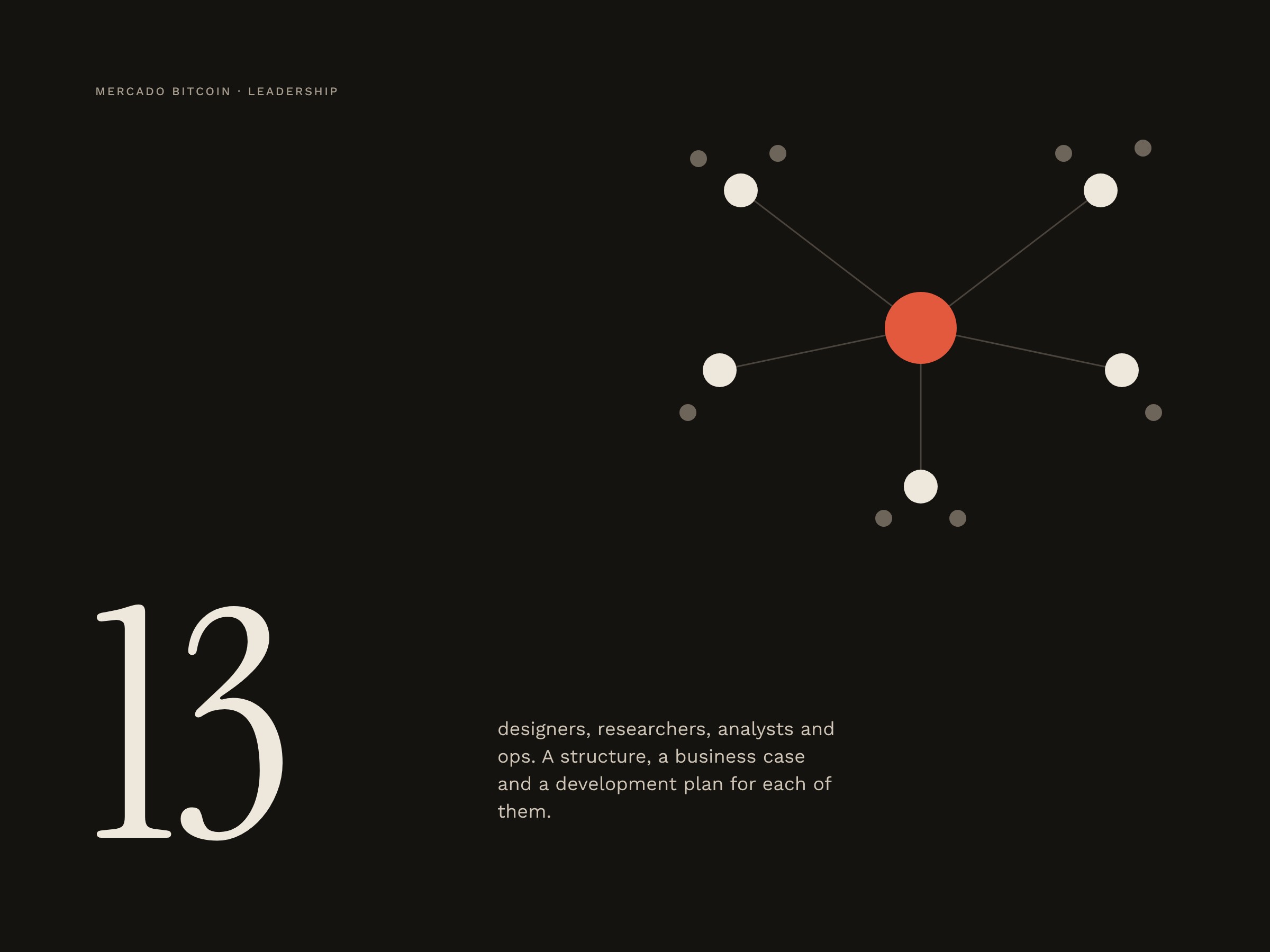
I built the management system with the team and the business, and not for them: a UX vision and goals, roles and responsibilities, a skills map for every person, a 360 review cycle, and a development plan where each person's SMART goals combined their own growth, the team's maturity and the business. One-to-ones every two weeks with all thirteen.
- 1EntryMinimal or no knowledge of the skill.
- 2SupportSome knowledge, needs support to execute.
- 3PerformApplies the skill without support, with basic confidence.
- 4DefineExecutes with autonomy and can mentor others.
- 5LeadExcellence at every level. Internal reference on the subject.
- 6GovernInternal and external reference. Influences the market.
| # | Product design | UX research | UX analytics | Design ops |
|---|---|---|---|---|
| 1 | Research | Analytical | Analytical | Analytical |
| 2 | Ideation | Direction | Direction | Collaboration |
| 3 | Build | Build | Build | Build |
| 4 | Strategy | Strategy | Strategy | Strategy |
| 5 | Business | Business | Business | Business |
Business meant knowledge of the company's world: blockchain, crypto and web3.
Where they are on each pillar, and where they want to go.
The design maturity the team needs next.
The impact the company can see.
One goal, one pillar, one business impact, one deadline. Reviewed in the 1:1s every two weeks.
| Example task | Goal | Business impact | Pillar | Deadline |
|---|---|---|---|---|
| Information architecture classes | Product usability | Revenue by improving UX | Build | Q4 |
| One course unit per month | Communication | Communication and networking | Strategy | Q3 |
The business case for Design Ops
I did not ask for a team. I showed what it would return. The proposal combined a small specialized Design Ops group serving many designers, and a distributed model where designers and developers inside the squads took on small ops tasks. The model assumed a 30% efficiency gain on design and front-end time across 24 squads, against the cost of a dedicated team and training, and projected a 190% return by the second year.
Specialized: a small group of Design Ops specialists serving many designers across small teams.
Distributed: designers and developers inside the squads take on small ops tasks with them.
- Ops program lead
- ResearchOps
- Design Ops specialists
- Mobile and front-end chapter
- Squads served
- 24
- Dedicated team
- 2 designers, 3 front ends, 1 tester, 1 researcher
- Assumed efficiency gain
- 30% of design and front-end time
- Value
- 30% of the annual cost of 24 squads' designers and front ends
- Cost
- The dedicated team, plus training
190%
ROI by the second year of Design Ops, in the model I presented. An estimate built on one stated assumption, not a measured result.
Making design measurable
Design had no metrics, so I designed the page that would show them, one per team: product and support satisfaction, the flow of design work, research done, the team's skills map and its maturity level.
00
00
00
00
0d
0d
00
→
Level 0
The hardest call
When the company cut headcount, I chose by performance, and not by tenure or salary. One of the people was already on a performance path before the layoff, a decision I had made earlier and on its own terms.
What stayed after
A team with a name, a vision, roles, a review cycle and a development plan per person, built so the next manager would inherit a system, and not a set of habits that lived in my head.