Philips Worklist Module.
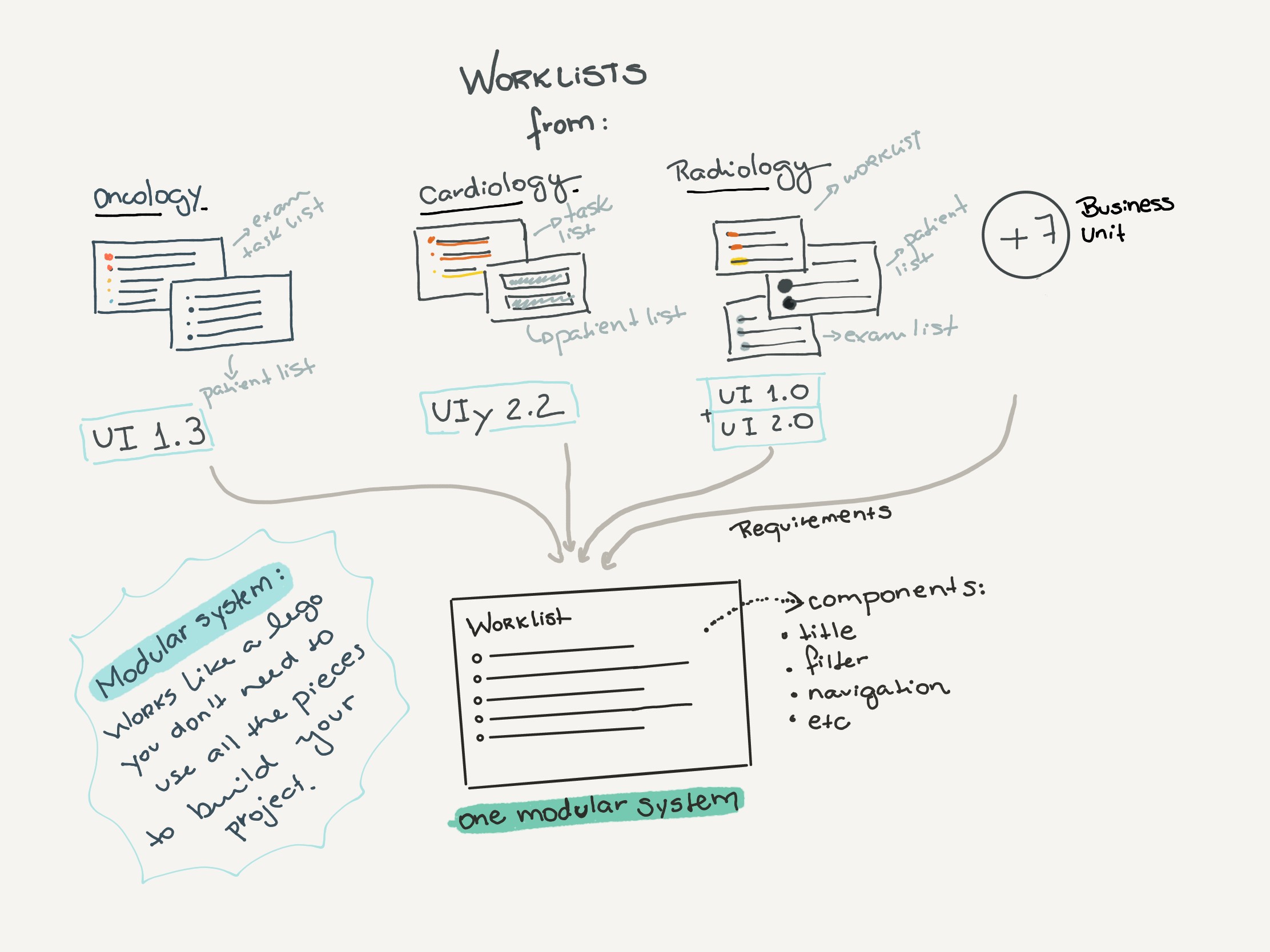
One modular worklist for more than ten products that each had their own.
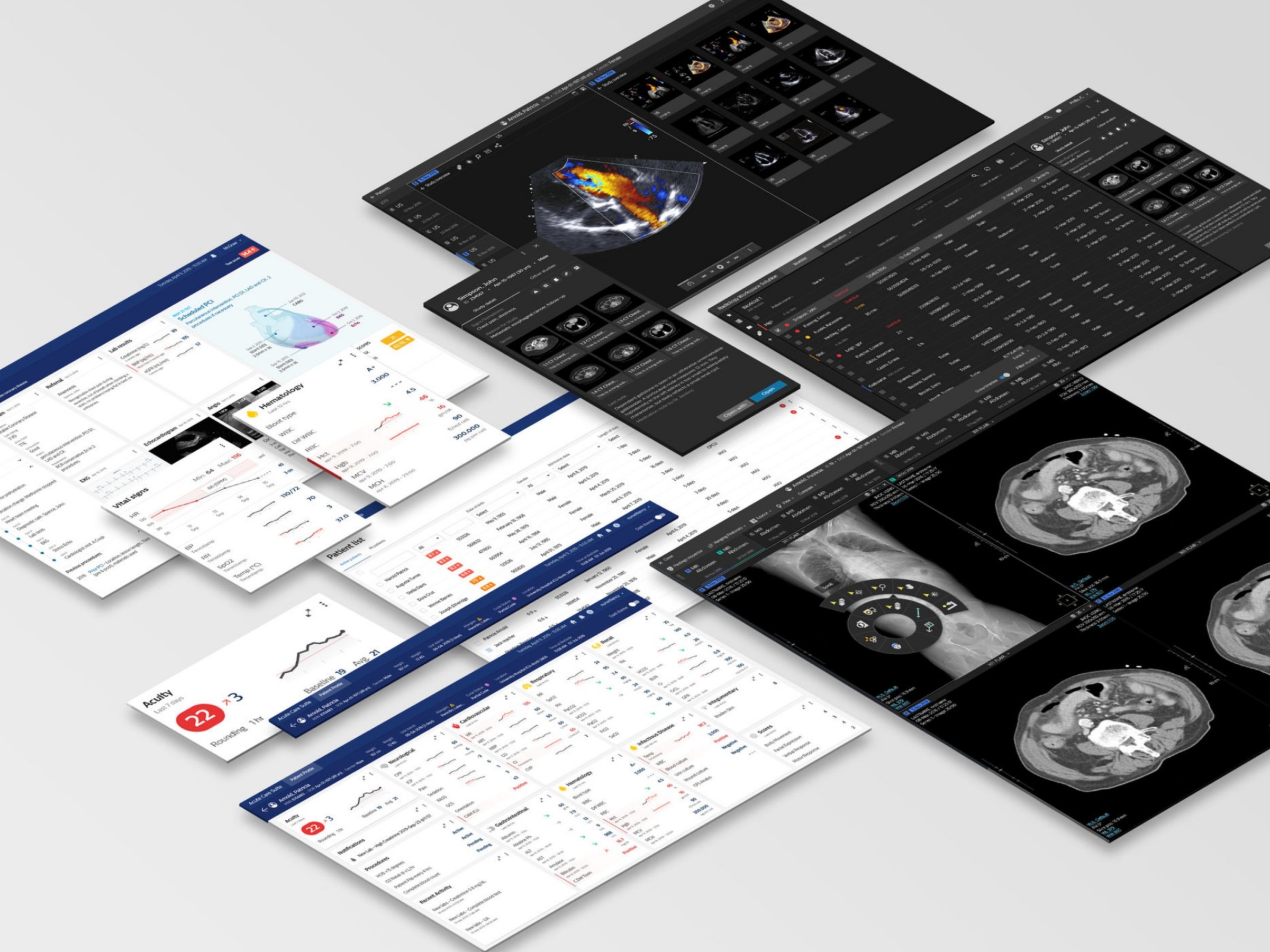
All Philips work is under NDA. Screens are replaced by redrawn diagrams.
The problem
The worklist is where a clinician starts after logging in: patient records, exams, studies. In some products it behaves like the home page. More than ten Philips products had their own worklist, in different design languages and with different patterns.
The call
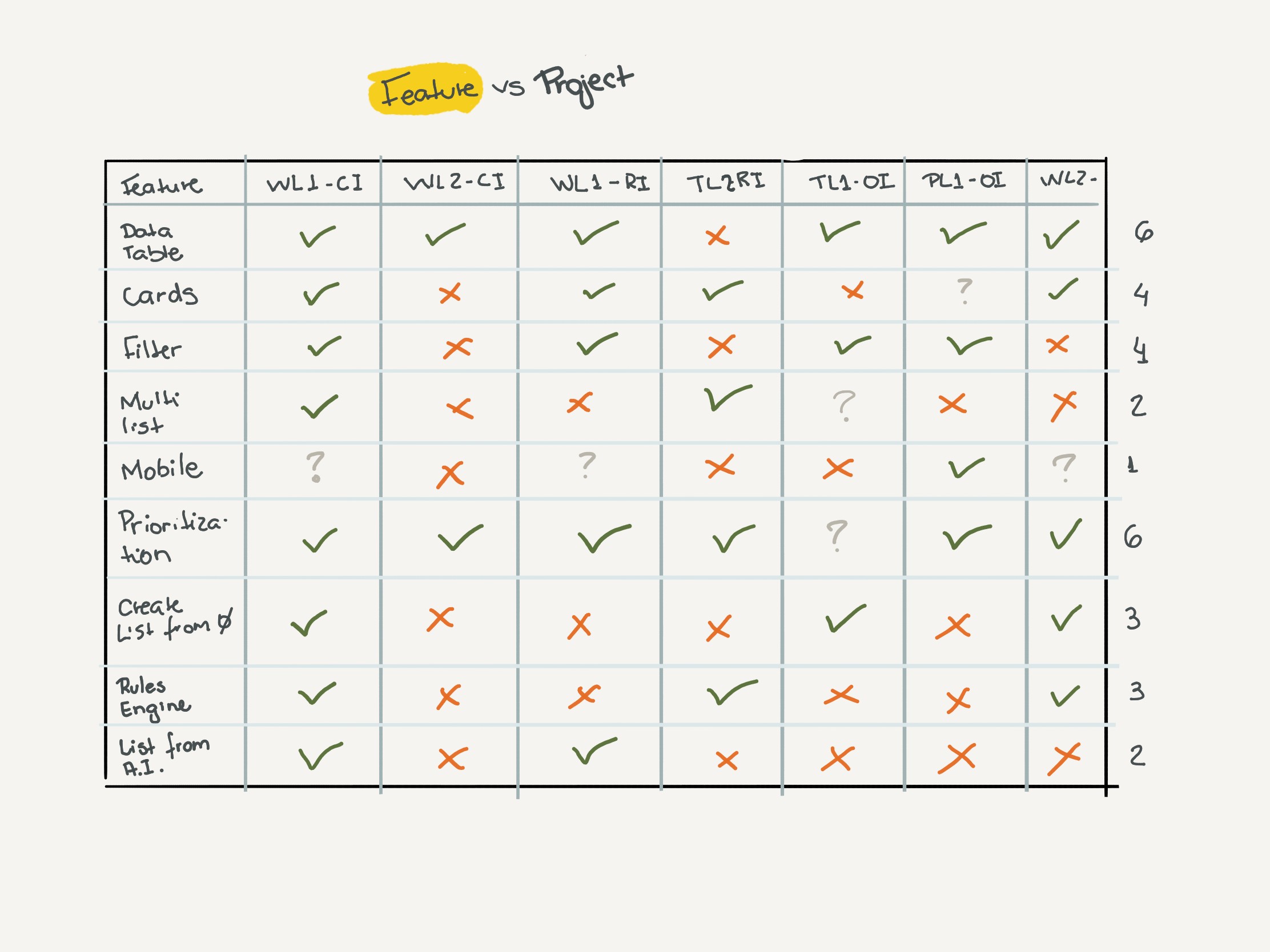
We documented every feature of every worklist as a user story and compared them side by side. Features were ranked by how many products used them, and not by who asked first. Data table and prioritization appeared in six of seven products, so they went first, with cards and filter. Building a list from scratch, rules, AI-made lists and mobile were real needs in fewer products, so they waited.
| Feature | WL1·CI | WL2·CI | WL1·RI | TL2·RI | TL1·OI | PL1·OI | WL2 | Products |
|---|---|---|---|---|---|---|---|---|
| Data table | 6 | |||||||
| Prioritization | ? | 6 | ||||||
| Cards | ? | 4 | ||||||
| Filter | 4 | |||||||
| Create list from scratch | 3 | |||||||
| Rules engine | 3 | |||||||
| Multiple lists | ? | 2 | ||||||
| List from AI | 2 | |||||||
| Mobile | ? | ? | ? | 1 |
Data table, prioritization, cards and filter. Present in four to six of seven products.
Building a list from scratch, rules, AI-made lists, mobile. Real needs, but not the first ones.
Redrawn from the original framing sketch. Product names replaced by codes, as in the source.
The module
A system built like bricks. A shared basics layer every worklist builds on, auxiliary components that move across domains, and custom components for one domain. A product uses the pieces it needs, and not the whole set.
- Custom
- Components specific to one domain.
- Auxiliary
- Components that can move across domains.
- Basics
- The common platform layer every product builds on.
CI, RI, ICAP, EMR and OI are the business domains the worklists came from. Redrawn from the original diagram.
How we validated it
The first pack of features came from a workflow common to ten products. Design review, then a workshop with internal validation, an iteration, a second validation round, and a report, over five months.
Design review
With designers interested in the module approach.
Workshop
Internal validation with medical specialists. 4 participants.
Iteration
Based on what February found.
Second round
Validation again. 6 participants.
Report
Validation report, open to every designer.
Designers from other products sent new requirements. The backlog was reprioritised by commonality and urgency.
- New requirements
- Documentation
- Prioritize features
- Design process
- Update design library
What stayed after
The module was built to be used without its author. Documentation lived on the official Philips design language hub, with a Sketch library on GitHub, collaborative documentation in Confluence, an interactive prototype, a video on how to combine components, and the validation reports, open to every designer. Every month designers from other products sent new requests, and the backlog was reprioritised by commonality and urgency.
- United States
- Brazil
- Netherlands
- Israel
- Bangalore, India
I was the main contact point: questions about worklists, requests for new features, and the channel between product designers and the module.
Design language hub
Fixed documentation on the official system
Confluence
Collaborative documentation
Sketch library
Versioned on GitHub
InVision prototype
Interactive, high fidelity
Video
How to mix and match components
Validation reports
Open to every designer